
Find Who Owns a Kent County Property
Each system answers a different piece. Kent County Property Search turns an address into a parcel and reports county Treasurer and Equalization data. The governmental unit names the city, village, or township assessor who keeps the local tax roll. Tyler Deeds Self-Service then reveals the latest recorded conveyance. No single screen proves ownership on its own. Used together, they settle the question without overclaiming.
- Search the address in Kent County Property Search and select the correct city, village, or township.
- Copy the PPN, property address, tax-roll owner or taxpayer label, and March data date.
- Ask the local assessor for a current property card if the transfer is recent or the snapshot appears stale.
- Search the tax-roll name as grantee in the Register of Deeds index and inspect the latest deed.
- Preserve any trust, estate, or entity role and consult the matching official source.
Keep a search log. Record the address form, municipality, PPN, names tried, instrument number, and dates, so a common name stays tied to the right parcel and any mismatch is easier to explain.
The municipality choice matters. A postal city can differ from the governmental unit. Kent County lists nine cities, five villages, and 21 townships, so a Grand Rapids mailing line does not by itself place land on the Grand Rapids roll. Read the governmental-unit result first. Then choose the local assessor who can confirm the tax name.
Kent County Search Fields Lead to the Property Owner
The Kent County Property Search accepts a parcel number or an address, not a name-only query. Address mode asks for Street Number, Range From, Range To, Street Name, and municipality. Parcel mode uses prefix 41. Sections run two, two, three, and three characters. Active parcels are checked by default. Inactive ones matter for an older address, split, merger, or retired lot.
| Search input | County use | Owner-search value |
|---|---|---|
| Street and municipality | Required address anchors | Finds the tax jurisdiction |
| Number or range | Optional exact or block filter | Narrows a building or parcel group |
| PPN sections after 41 | Direct parcel search | Joins the same land across records |
| Active or inactive | Current and retired results | Connects records across parcel change |
The official Kent County search screen shown below documents the input modes and CAPTCHA.
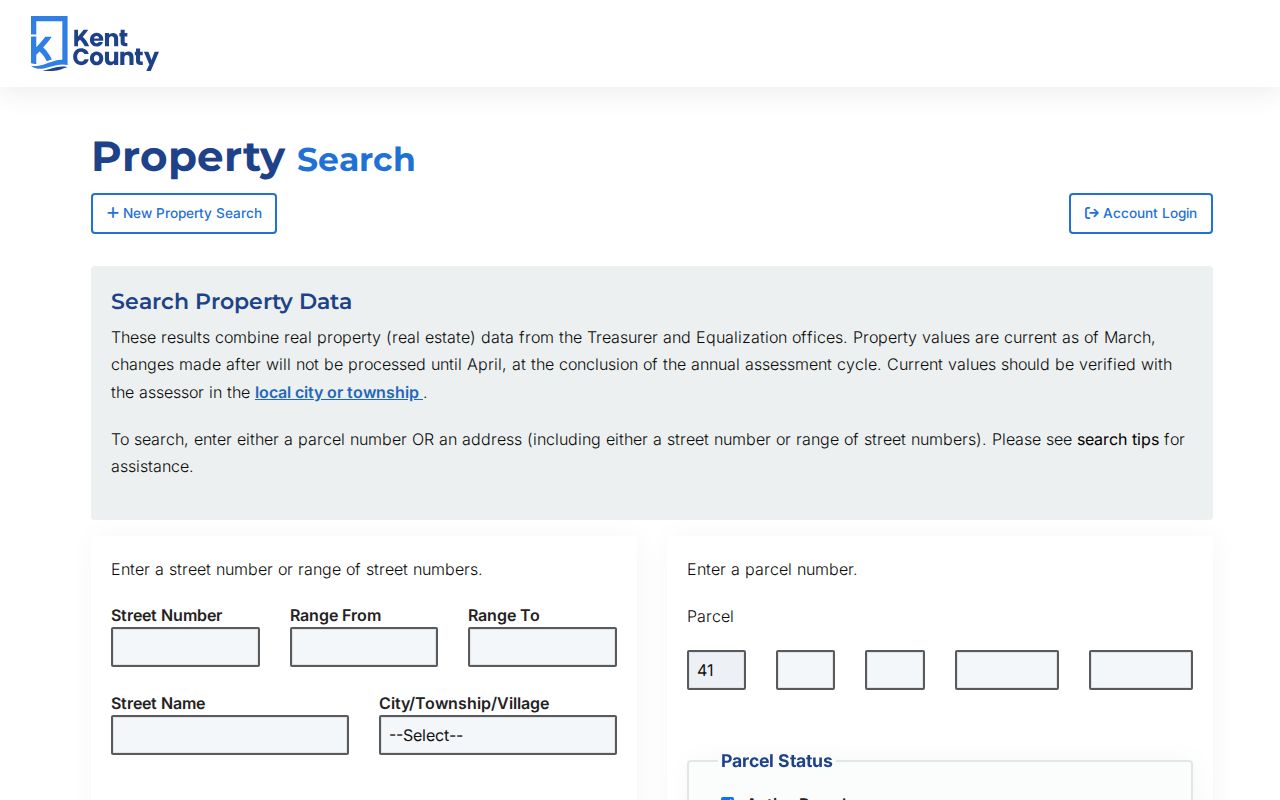
An address can fail for small reasons. Strip punctuation and street-type words, drop the directional suffix, and test the right governmental unit instead of trusting the postal city.
Where Kent County Property Ownership Appears
No single county screen does everything. The assessment roll handles current tax administration. GIS gives spatial context, and the Register of Deeds index points to instruments. A court or probate file may explain authority or a dispute. The later recorded deed is the key title event to check.
| Record layer | Name or fact shown | Timing | Role |
|---|---|---|---|
| Assessment roll | Owner, taxpayer, care-of, mailing address | County snapshot current as of March | Fast owner lead |
| Register of Deeds | Grantor, grantee, instrument, legal description | By recording date | Confirm the conveyance |
| GIS parcel layer | OWNERNAME1/2, taxpayer, PPN, geometry | Use edit and source date | Join name to map |
| Court or probate | Parties, fiduciary authority, order, status | By filing and order dates | Explain a transfer path |
State what each record displays, and when. A mailing address can belong to a taxpayer or fiduciary and says nothing about who occupies the property.
The March Snapshot Can Trail a Kent County Deed
Kent County's Property Search combines Treasurer and Equalization real-property data through the annual cycle ending in March. Changes after that point wait for the next cycle. A deed recorded later can name a new grantee. The county page may still show the earlier tax-roll label.
Call nothing an error yet. Grand Rapids, Wyoming, Kentwood, and every other city or township keep their own assessment layer. Put a source date beside every copied name. The deed recording date, municipal update date, and county snapshot date are three separate events.
Note: A recent sale is the strongest reason to compare the county result with both the local card and latest deed.
Trace the Kent County Property Owner to a Deed
The Kent County online deed search offers free basic index searching from January 1, 1970. Search the assessment name as grantee. Then inspect the most recent likely conveyance. Match the legal description, PPN or prior reference, document number, and date. Try spelling variants, middle initials, entity suffixes, former names, and both party roles.
The index is a locator, not the instrument. Current terms charge $1 per page for image download or printing. Previews may stay blurred until purchase. If the portal fails, visit or write the Register of Deeds at 300 Monroe Ave NW, Grand Rapids. Bring a document number, party, date, type, and legal description. Recording service ends at 4:30 p.m. The public office closes at 4:45 p.m.
That comparison is the finish line. The Kent County deed records guide covers copies and instrument mechanics. For this owner question, stop there. The latest matching conveyance has now been compared with the assessment name.
Identify a Kent County LLC, Trust, or Estate Owner
The owner of record is not always a person. Copy the name exactly as the deed records show it. A registered agent, manager, trustee, or personal representative is not automatically the owner of record, so do not promote one of them to parcel owner unless the deed supports it. Businesses are easier. Michigan's MiBusiness Registry Portal offers Begins with, Exact match, Keyword, and Soundex entity searches, plus lookups by entity ID, filing number, and role. A filing confirms the entity's identity and state roles. It does not prove ownership of every parcel tied to the name. Estates work differently. Kent Probate Name Search can locate a file and show who holds authority. An order, assignment, or death record may not complete a land transfer, so return to the deed index for a later conveyance. Trusts often lack a business-registry entry. You may need a recorded trust instrument, affidavit, or trustee deed instead. Instrument type matters. Correction deeds, quitclaim deeds, survivorship affidavits, land contracts, and personal-representative deeds all read differently in the property records, so keep the label rather than calling everything a deed. A correction can fix a name or legal description without any market sale, while a fiduciary filing may show authority rather than personal ownership.
Kent County Fraud Notify Watches a Recorded Name
Kent County launched Fraud Notify in March 2024. The free email alert flags new documents by name. Each notice covers a personal, business, or trust name you submit and includes the document number, type, recording date, matched name, and a Self-Service link. Registering only the first two letters catches more name variants. It also adds false positives. An alert arrives after recording and cannot stop fraud, prove validity, or replace title review. The official Fraud Notify instructions on the county site explain the sign-up steps.
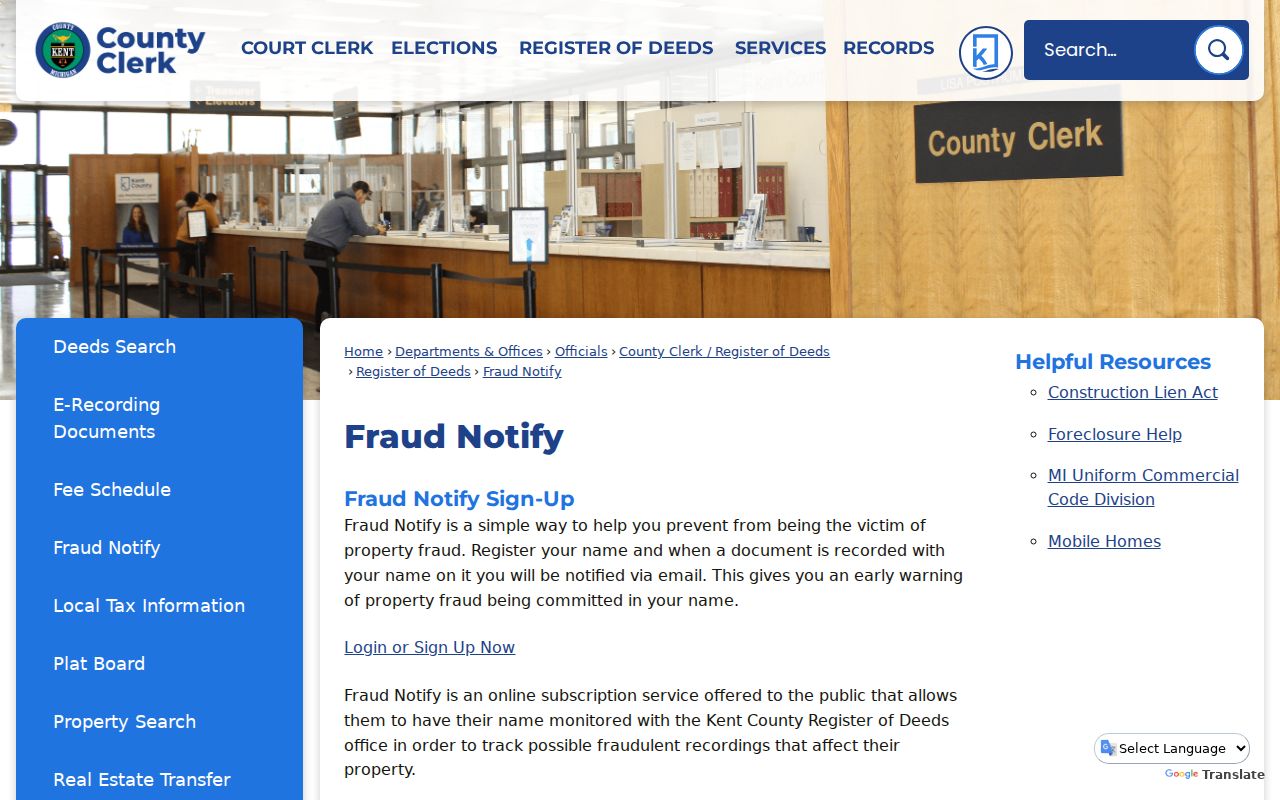
It watches a known name, not an unknown owner.
Limits on Who Owns a Kent County Property
An owner lookup answers one narrow question. It cannot show who lives at an address, whether anyone is present now, an unpaid mortgage balance, or whether title is free from every claim. Tax, GIS, and deed indexes are imperfect. Delays, spelling variants, and indexing errors all appear. Michigan's Address Confidentiality Program gives qualifying people a substitute address and mail forwarding, so never try to reverse-engineer a protected residence.
Lawful use. Use Kent County owner records for legitimate property research, purchase diligence, estate work, or civic questions. Never use a name or address to stalk, harass, intimidate, or harm anyone.
An online property records result is just a starting point. It is not a title search or title opinion. For a purchase, easement, boundary dispute, or ownership conflict, have a qualified Michigan attorney or title professional examine the full chain. When online systems fall short, the local assessor can produce the property card. The Register of Deeds can pull a specified instrument. Kent County also answers focused Freedom of Information Act requests for a non-exempt record held by the right department. Name the PPN, address, municipality, record class, custodian, and date range. FOIA creates no title summary and will not disclose exempt details. Older questions can outgrow the online deed records index. Kent County treats January 1, 1970 as the basic deed-search coverage floor. Work before that date may require the Register of Deeds, deed books, tract abstracts, the Library of Michigan, or the Archives of Michigan. An 1860 fire destroyed the original early deed books. Surviving pre-fire evidence may come from Leonidas Scranton's tract-book abstracts rather than an original deed image. Label an abstract as an abstract. Keep its reel or book reference. Connect it to later instruments that repeat the prior conveyance.