
Kent County Tax Record Fields
Kent County property tax records combine several layers. The county Property Search blends Treasurer and Equalization data. For a correction, exemption, or value challenge, the local city or township assessor remains the source of the current roll. The annual snapshot is current through March. A transfer recorded later may not appear until the next assessment cycle.
| Field | What It Shows | Where |
|---|---|---|
| True cash value | Estimated usual selling price under Michigan assessment law | Local assessor |
| Assessed value and SEV | Normally 50 percent of true cash value after equalization | Assessor and Equalization |
| Taxable value | Value to which millage is applied | Assessment roll and bill |
| PRE status | Principal Residence Exemption treatment | Local assessor |
| Bill and delinquency | Amounts billed, paid, due, or forwarded | Local then county treasurer |
A tax bill is not a sale appraisal. Michigan separates true cash value, assessed value, state equalized value, and taxable value, and each answers a different question. A transfer can uncap taxable value the following year. That is why two similar homes can carry different taxable values, and the consideration on a recorded deed is yet another number with its own limits.
Kent Property Search Inputs
The official Kent County Property Search also asks for the governmental unit, a useful safeguard where the same street name appears in more than one municipality. It accepts an address or a parcel number. No countywide owner-name-only search exists.
| Field | Format | Use |
|---|---|---|
| Street number | Exact or range | One parcel or a block |
| Street name | Text, normalized | Address match |
| Municipality | City, village, or township | Selects the tax unit |
| Parcel sections | County prefix 41 plus four parts | Exact parcel search |
| Status | Active or inactive | Finds current or retired parcels |
The result card lists the PPN, situs address, owner or taxpayer label, values, sale history, and active status. Keep the tax year and retrieval date beside it. Those details keep a saved copy meaningful months later.
Kent Tax Billing Calendar
Regular bills go out July 1 and December 1. Unpaid amounts move to Kent County after March 1. That handoff changes the custodian. The local treasurer answers current billing questions. The Kent County Treasurer collects delinquent real-property taxes and administers later foreclosure work. Per the county FAQ, delinquent taxes carry a 4 percent administrative fee plus 1 percent monthly interest, with later statutory charges possible. The county's online tax help service can add a property, display a bill without payment, accept partial or multiple payments, and show the impact of ongoing charges. Confirm the live balance before acting. The official Kent County tax guidance maps the full billing and delinquency route.
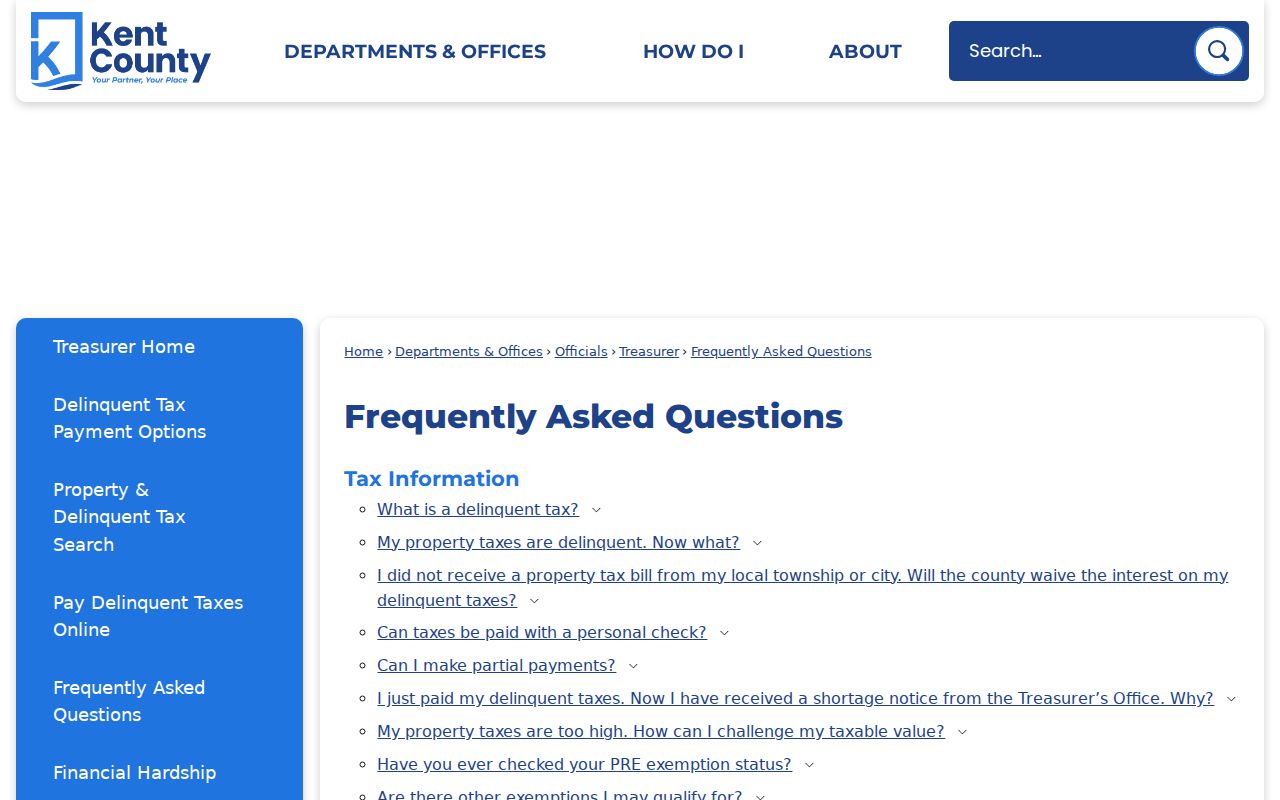
It helps you tell a current local tax bill apart from a delinquent balance the county now holds.
Look Up Kent Tax Bills
Use a parcel number when possible. It avoids street spelling and postal-city errors. Keep the governmental unit and tax year beside the PPN, since regular bills and delinquent records can sit with different offices.
- Search the county Property Search by normalized address or the four-part PPN.
- Confirm the municipality, tax year, SEV, taxable value, and PRE field with the local assessor.
- Check the local treasurer for the current bill and the county Treasurer for post-March delinquency.
- Record payment status, fees, foreclosure stage, and the retrieval date.
- Assessed value
- The assessor's value before equalization, generally half of true cash value.
- Millage
- The rate applied to taxable value to calculate tax.
- Principal Residence Exemption
- Michigan relief tied to a qualifying principal residence.
- Tax lien
- A public claim arising from unpaid property tax.
Kent Delinquency and Foreclosure
Delinquent-tax records are not mortgage-foreclosure records. Mortgage foreclosure runs through a different chain of records. That chain includes recorded mortgages, assignments, notices, sheriff-sale material, and court files. Search the correct chain first. The Treasurer manages the delinquent side. That office collects delinquent real-property tax and handles sales after a court order. Treasurer resources include a delinquent search and foreclosure proceeds forms. They also offer auction results, land-division tax certification, and millage material. A solid request names the PPN and municipality. Include the year, plus whether the amount is current or delinquent. Also note whether foreclosure has reached a court or sale stage.
March Snapshot Timing
Kent County's March snapshot creates a predictable mismatch. A deed recorded in April can sit validly in the Register of Deeds index while the public tax record still shows the prior cycle's name or value. Neither source is wrong. The Appraisal Division audits transfers and applies them in the following cycle, so preserve both dates rather than calling one record mistaken. A sound comparison notes the deed date, assessment year, and data-as-of date. Add the assessor card and next year's taxable treatment. Uncapping lands the year after the transfer. Michigan rules set that timing, with exemptions, so check it whenever you review Kent County property tax records after a sale.
Michigan Values on Kent Bills
Michigan assessment terms explain why one Kent County bill can show several values. True cash value is the usual selling price. Assessed value normally runs 50 percent of that figure. State equalized value reflects equalization. Taxable value is the millage base, subject to caps, additions, losses, exemptions, and transfer rules.
A sale does not reset every number. The year after a transfer, taxable value generally uncaps to the assessed value, then resumes the statutory cap in later years. The assessor also decides whether a sale was arms-length for study purposes, and a deed may show nominal consideration, an exemption, or an allocation across several parcels.
Compare one tax year at a time. Taxable value drives the bill. Save the notice date, assessment year, AV, SEV, taxable value, PRE status, millage, and billed amount. A tax roll is value evidence. It is not a current appraisal.
Kent Tax Record Requests
When the portal lacks history, ask the custodian. Start with the parcel. Know the PPN, the municipality, and the tax year. Then decide exactly what you need, whether a current bill, a historical bill, payment history, a delinquent balance, foreclosure status, sales history, the tax description, or an assessment card. The county FOIA page lists several of these as common property requests and notes the annual update cycle.
The request itself may be verbal or written. It just has to describe the record: department, record type, address, parcel, and date range. Electronic requests are received one business day after transmission. The county then has five business days to respond. A ten-business-day extension is possible, and search, review, copying, deposits, exemptions, and redactions can each affect the response.
FOIA is not always needed when a public portal or a routine copy process supplies the record. Start with the local assessor or treasurer, move to the county Treasurer after delinquency, and reserve FOIA for identifiable non-exempt material that stays out of reach.
Contest a Kent Assessment
An assessment dispute starts with the local city or township assessor, not with county deed staff. Pull the annual notice first. Then review the property card, classification, measurements, sale study, exemptions, and comparable evidence. March Boards of Review handle the regular local appeal. A later Michigan Tax Tribunal route depends on property type and statutory filing rules. Build the full record set before filing. Save the notice, property card, land and improvement values, building sketch, class, acreage, PRE status, transfer history, and the assessor's study area. Check the facts before arguing value. Wrong square footage, a wrong class, a parcel split, or a bad condition entry is not the same as a dispute over the mass-appraisal result.
Timing shapes the route, and each Kent municipality publishes its own March Board of Review dates and petition instructions. The local assessor can explain the current submission process, and state tribunal deadlines then depend on property type and the local decision. A past schedule is not a safe deadline for a new appeal. Match comparable evidence to the assessment question. Local assessors may publish ECF, land-value, or neighborhood sales studies, but a study sale is not automatically comparable to the subject parcel. Preserve the study year, class, area code, and sales window. An ECF area is an appraisal group. It is not a legal subdivision.
Keep liability separate from value. PRE status, millage, special charges, delinquency, and payment history can change a bill without moving true cash value. A value correction may not clear a prior-year balance. Ask the assessor about the roll and exemptions. Ask the correct treasurer about bills, payments, fees, and delinquency.
Tax foreclosure adds its own record chain. The county Treasurer manages delinquent real-property tax. Sale happens only after a court order. Auction results show a sale event, not the complete title history, so match the parcel, tax years, judgment or order, auction result, and later deed. Mortgage foreclosure follows different recorded and court records, so keep it apart from the delinquent-tax process. For a parcel-specific request, state whether you need a current bill, a historic bill, payment ledger, delinquent balance, foreclosure status, sales history, tax description, or assessment card. Add the PPN, municipality, tax year, address, and date range so the assessor, local treasurer, county Treasurer, or FOIA coordinator can route the request to the right file.
Appeal window. Kent municipalities publish their own March Board of Review schedule. Check the current notice and local deadline before filing.
Bring parcel-specific evidence to the hearing. A deed price helps, but it does not control the assessment by itself. Photographs, measurements, and condition facts support the claim. So do relevant comparable sales, exemption documents, and a dated property card. Together they make the claim easier to test. For what each number means apart from the bill, see the Kent County property value explanation.