
Kent County Value Types Compared
Michigan tracks a few different values for every parcel. True cash value is the assessor's best estimate. It reflects what the property would usually sell for. Assessed value sits at 50 percent of that estimate. State equalized value, or SEV, is what remains after equalization. Taxable value is usually the lower of SEV or capped value. A transfer of ownership uncaps it in the next assessment year. The recorded sale amount, meanwhile, lives in a separate transaction record.
| Value label | Meaning in Michigan | Official record |
|---|---|---|
| True cash value | Mass-appraisal estimate of usual selling price | Local assessor notice or property card |
| Assessed value | Normally 50 percent of true cash value | Local assessment record |
| SEV | Assessed value after county and state equalization | Assessment roll and county data |
| Taxable value | Value to which millage is applied, subject to the cap and transfer rules | Tax or assessment record |
| Sale or consideration | Amount reported for a transfer, subject to deed context and exemptions | Recorded deed and transfer-tax evidence |
Dividing the last sale price by two does not reproduce the assessed value. Local assessors work from mass appraisal and market studies. They also draw on land values, building data, and economic condition factors. And not every deed reflects an open-market sale. A nominal, exempt, family, trust, or multi-parcel transfer can distort the picture. Keep the field label and tax year attached to every Kent County property value.
Kent County Value Assessment Ratio
Michigan law and assessor guidance keep assessment and taxable value distinct. The assessor first estimates true cash value. Assessed value is set at half of it. Equalization then produces SEV. Because annual increases are capped, taxable value can stay below SEV for years. A transfer of ownership finally uncaps it for the following year, subject to statutory exceptions.
That sequence explains a common mismatch. A property transferred in 2025 can see taxable value reset to assessed value for 2026. The sale amount itself never becomes the new taxable value. Grand Rapids and Wyoming publish local guidance that follows the state model. The county's Equalization and Appraisal divisions audit values. They carry transfer treatment through the annual cycle.
Find a Kent County Assessed Value
Start with the county portal. But for the local property card, the city or township assessor is the better source. A recent correction also comes from that office. Search by the parcel's actual governmental unit, not just the postal city. And before comparing numbers, preserve the year and data date. The official Kent County Property Search entry screen shows its parcel and address routes.
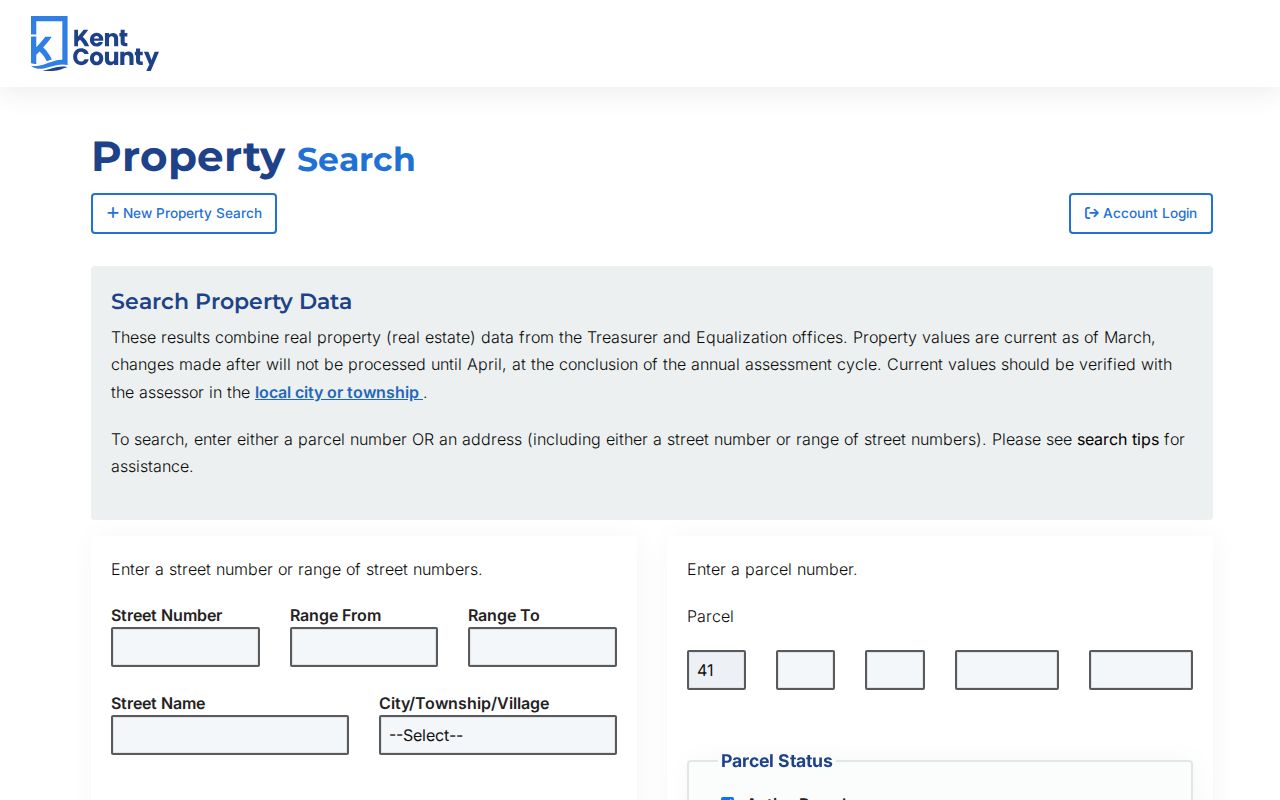
The value lookup depends on a few settings. Pick the right municipality, choose between active and inactive parcels, clear the CAPTCHA, and heed the March data notice before trusting any figure the tool returns.
- Locate the address or PPN in the Kent County Property Search. Confirm the municipality and whether the parcel is active.
- Copy each displayed field exactly, including SEV, taxable value, property class, sale-history label, and the assessment year.
- Check the local assessor property card for true cash value, assessed value, land or improvement detail, and a more recent local update.
- Read the recorded deed and transfer-tax treatment before treating a reported sale amount as market evidence.
- Compare only like periods and sources. A March county snapshot, later deed, and following-year uncapping belong to different dates.
- Assessed value
- One-half of the assessor's true cash value estimate before equalization.
- True cash value
- Michigan's mass-appraisal estimate of usual selling price.
- Assessment ratio
- The 50 percent relationship between assessed value and true cash value.
- Sale consideration
- The amount stated or supported in a transfer record, which may need context.
- Reassessment
- The annual process of reviewing and setting values, distinct from a private appraisal.
Note: County Property Search reflects a March annual-cycle snapshot, so a later local change or a recorded deed may not appear until a future refresh. Timing gaps are normal.
Kent County's March Value Snapshot
Kent County merges Treasurer and Equalization real-property data. It describes that data as current through the annual cycle ending in March. Anything later waits. The Appraisal Division audits each transfer so the correct taxable and SEV treatment carries forward. That audit step creates a normal timing gap. A closing, a deed recording, a local assessor update, and the county display can each land on different dates. So keep notes. Record the retrieval date and the tax year whenever you pull a parcel. Say a deed was recorded in April. Compare it against the March county snapshot, then check the following assessment year for uncapping. Don't call it an error without assessor confirmation. Physical changes lag too. A permit may reveal an addition, demolition, or renovation before the next property card catches up. An assessor's photograph or sketch, in turn, can predate the recorded transfer. Deeds document conveyances, permits document authorized work, and assessment records support the annual valuation, so their dates should read as a chronology rather than one blended current value.
Kent Sale Price Evidence
A transfer-tax stamp can back the stated price. Kent County expects an instrument to state total consideration or arrive with a Real Estate Transfer Valuation Affidavit, and any exemption should appear on the deed itself. County transfer tax runs $1.10 per $1,000. State transfer tax runs $7.50 per $1,000, with exemptions and current terms applying. Read the county transfer-tax guidance alongside the deed. A nominal, exempt, or allocated amount is not proof of market worth. A sale-history row is only a lead. The instrument itself names the exact parties, the date, the legal description, and the tax treatment.
Kent Equalization Sets Context
Every Kent County homeowner's tax bill starts with the Bureau of Equalization. This office reviews assessment rolls from 21 townships and nine cities. Its job is to level the playing field. Local assessors estimate parcel values independently, and equalization adjusts each jurisdiction so assessments countywide sit at a uniform fraction of market value. The annual report reflects that work.
The totals are big. The 2024 report lists a county equalized value of $47,555,098,428 and a taxable value of $33,663,337,200, with taxable value at 73.52 percent of SEV. Those figures describe the whole tax base, though. They say nothing about a single house.
Never divide them into a county average and pin it on a parcel. Taxable value and equalized value are not interchangeable either. A Kent County property value depends on the parcel record itself: its parcel number, year, class, and local assessment context.
Kent County Local Value Models
Grand Rapids reviews a slice of the city each year. The rotation covers 130 residential single-family neighborhoods. Exterior reviews, photographs, and neighborhood trends shape the mass-appraisal inputs. January notices and economic condition factor studies do too. An ECF is a model input for a market group. It is not the sale price of every parcel in it.
Wyoming maintains roughly 25,000 parcels. It studies arms-length sales. The study runs from April 1 two years prior through March 31 of the current cycle. Economic areas may follow geography, school districts, history, or amenities. Keep the named study area and year intact. For local detail, start with the county lookup. Grand Rapids BS&A, Wyoming BS&A, Kentwood BS&A, or the right township assessor can help.
Where Kent Property Values Live
The county GIS schema carries fields like SEVTRIBUNAL1, TAXABLETRIBUNAL1, property class, and acreage. Those fields help map and compare records. Still, provenance and edit date matter. The assessment card explains how a value was derived. The deed holds the transfer instrument and declared consideration.
The official Property Description and Mapping route handles parcel-description issues. A value tied to the wrong active or inactive parcel helps nobody. Fix splits, mergers, condominium units, and parent PPNs first. Only then compare a historic sale with a current assessment.
For a clean comparison, build one row per year and source. Record true cash value if available. Also record assessed value, SEV, taxable value, transfer date, declared consideration, property class, and the record's as-of date. Flag whether a sale was arms-length, exempt, or nominal when the source says so. Note if it was part of a multi-parcel transaction. That discipline prevents sloppy matchups. An old deed amount, a current assessed figure, and a countywide aggregate answer different questions.
Kent Property Value Limits
An assessment is a mass-appraisal result used for property taxes. It rarely matches a current offer, private appraisal, insured replacement cost, or lender valuation. The date of analysis matters too. Condition, renovations, unusual easements, financing, and transfer type move real transactions, and the public record can lag a recent change or sale.
Value is not price. A Kent County assessed value is for taxation and does not predict what a property will sell for. A licensed appraisal addresses a specific valuation assignment.
Tax bills, exemptions, delinquency, and appeals belong to Kent County property tax records. Valuation research is a narrower task. Identify the label, source, year, and transfer status. Then ask why the compared figures differ.
Always preserve the source date. When a private appraisal and a public assessment disagree, compare their effective dates, condition assumptions, land area, improvement data, and intended use. A valuation built for a sale or loan answers a different question than an annual mass assessment. Neither number substitutes silently for the other, even when both carry the same calendar year.