
Kent County Deed Types
Instrument type comes first in Kent County deed searches. The Kent County Register of Deeds records deeds, mortgages, land contracts, liens, and other instruments affecting real property. A deed shows a recorded transfer. A mortgage secures a debt. A discharge records that a mortgage was released. A land contract can show a seller-financed interest without a deed's effect, so read the instrument label before treating any party name as proof of ownership.
| Deed Type | What It Does | Common Use |
|---|---|---|
| Warranty deed | Conveys the grantor's interest with stated covenants | Conventional sale or transfer |
| Quitclaim deed | Conveys whatever interest the grantor holds | Family, estate, or title cleanup |
| Executor or fiduciary deed | Conveys property through an authorized estate representative | Probate or estate administration |
| Tax deed | Records a transfer after the tax-foreclosure process | Delinquent-tax property |
| Land contract | Records the parties' contract interest | Seller-financed transactions |
The label on each entry controls what it means in Kent County deed records. A deed transfers an interest. A mortgage or lien is an encumbrance, a claim or burden tied to the property. An assignment may move a mortgage interest. A discharge may release it. That is why a complete property search follows conveyances and their related instruments rather than counting every recorded item as a sale.
Kent Deed Index Coverage
The county's online deed-search notice offers free basic searching for land records. Coverage runs from January 1, 1970. The index is a locator, not the instrument. Tyler's disclaimer compares it to a card catalog. Indexed data can change. Before concluding that no record exists, try spelling variants, initials, business-name forms, and trust names.
Online access has limits. Paid image viewing or download is listed at $1 per page. Unpaid previews may appear blurred. Advanced access unlocks the full index back to the same 1970 start under time-based plans. Those terms can change, so confirm them on the county page before purchasing. Kent County deeds from before the digital era require the office. Deed books, tract books, archives, and other historic finding aids hold the rest.
Note: Record the query, date, spelling used, and every instrument reference so another researcher can repeat the deed search.
Kent Grantor-Grantee Chain
Kent County deed records are organized by party in the grantor-grantee index. A grantor conveys an interest. A grantee receives it. Start from a likely current tax-roll name, confirm that name in the recorded index, and preserve the document number, recording date, instrument type, legal description, consideration clue, and any prior book-and-page reference.
- Find the likely current owner's deed by searching that party as a grantee.
- Open the instrument and record the grantor, legal description, prior reference, and recording identifier.
- Search the grantor as a former grantee to locate how that party acquired the same land.
- Repeat while the legal description and parcel history align. Switch to deed books or archival aids before 1970.
- Grantor
- The party conveying the interest.
- Grantee
- The party receiving the interest.
- Chain of title
- The linked sequence of conveyances for the same land.
- Book/page
- A volume and page citation used for a recorded item.
- Instrument number
- A unique modern recording identifier.
A name match alone proves little. Compare the municipality, parcel number, legal description, spouse or co-owner names, and prior references before accepting it. Trusts, estates, and companies appear under many forms. When a company is a deed party, the Michigan business-entity search can confirm its exact legal name, though it does not establish parcel ownership.
Kent Deed Search Fields
Not every deed search runs through a web form. A written request works too. The facts that make a written request useful are the same ones that sharpen any search. Start with the strongest known identifier, then add party and date details when the property has a long chain.
| Search clue | How it narrows Kent records | What to preserve |
|---|---|---|
| Grantor or grantee | Finds indexed parties and name variants | Exact spelling and role |
| Document number | Targets one instrument | Full identifier and date |
| Instrument type | Separates deeds, mortgages, liens, and releases | Index label |
| Parcel or legal description | Connects a name hit to the land | PPN, lot, block, plat, or metes-and-bounds text |
Kent County's Property Search supplies a PPN and a tax-roll lead, but it offers no owner-only county search. It reflects one snapshot each year, taken in March. Use it as a first crosswalk only.
Transfer Tax Clues
A recorded Kent County deed often carries transfer-tax stamps, and those stamps encode real numbers. The county charge is $1.10 per $1,000 of consideration. The state adds $7.50 per $1,000. Both figures appear on the instrument unless an exemption applies. The county's own explanation puts payment on the seller, or grantor.
Treat stamps as evidence, not gospel. Nominal transfers, family conveyances, estate distributions, and price allocations split across several parcels. These can all distort the apparent sale price. So can exempt transfers, which skip the stamps entirely. A cleaner read comes from setting the deed language beside the assessor's sale history. It also weighs the tax-year values on the tax roll. One more caution: keep the recording date, the execution date, and the later assessment update separate. They rarely land on the same day.
Kent Deeds Before 1970
Kent County's digital deed records stop well short of its full land history. The Library of Michigan and the Archives of Michigan publish guides to deed indexes, maps, atlases, assessment rolls, and county record series. Those guides reach further back. One break matters most: an 1860 fire destroyed the original Kent deed books. Without those volumes, earlier chains depend on substitutes. Leonidas Scranton's abstracts and later tract books carry key links. They cover the 1830 to 1860 period.
So an early chain of title may cite an abstract rather than a deed image. Label each source and its medium precisely. Old maps help too. The 1855 plat map, the 1876 atlas, and the 1907 atlas can reconcile vanished place names. A map label alone proves nothing, though. Check it against a recorded plat or the legal description in the deed records. Grand Rapids research adds another layer. City assessment rolls survive from 1926, and appraisal cards run from 1936 through 2009.
Online cutoff: Basic online Kent County deed records begin January 1, 1970. Earlier work may require deed books, tract abstracts, archives, and office help.
Fraud Notify Recording Alerts
In 2024, Kent County rolled out a free monitoring service called Fraud Notify. Register a personal, business, or trust name. The county then sends an alert whenever that name shows up on a newly recorded deed or other instrument. Think of it as an early-warning bell. It rings after the document hits the deed records, never before. So it cannot block a fraudulent filing. It is no substitute for reading the deed itself.
The county's own Fraud Notify instructions walk through registration. They also explain how the recording-name alert works.
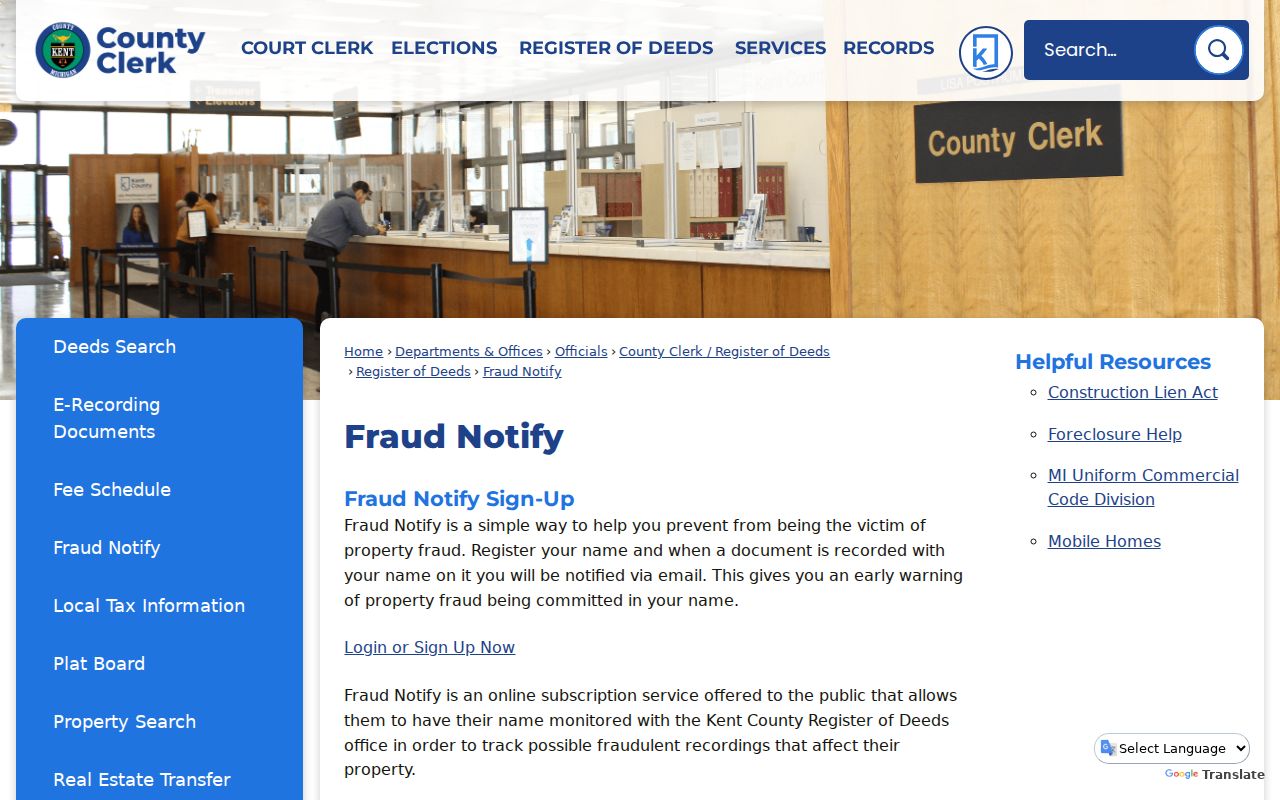
The county is blunt about the service's limit. An alert follows a recording. It does not prevent one. For better coverage, Kent County suggests registering just the first two letters of a surname, which catches spelling variants at the cost of extra false matches. Each alert identifies the recorded document, so the recipient can pull it, read it, and call the Register of Deeds with questions. That makes Fraud Notify a solid way to watch a Kent deed trail, but it says nothing about whether title is clear.
Order a Kent County Deed
Plain and certified deed copies both come from the Register of Deeds. You can buy images online through the index. Prefer mail or a visit? Include the recording number if you have it, plus instrument type, parties, date, parcel number, or legal description. The office sits at 300 Monroe Avenue NW in Grand Rapids, reachable at 616-632-7610. Recording cutoff is 4:30 p.m. The counter stays open until 4:45 p.m.
Costs are set out in the county fee schedule. Real-estate record copies run $1 per page, with a $5 minimum search fee and $5 to certify a document. Most real-estate instruments record for $30 each. Card charges and payment terms shift over time. Confirm them before ordering. One other thing: the office sells no blank deeds and gives no legal advice.
For current copy and certification charges, the linked Register of Deeds fee table is the authority.
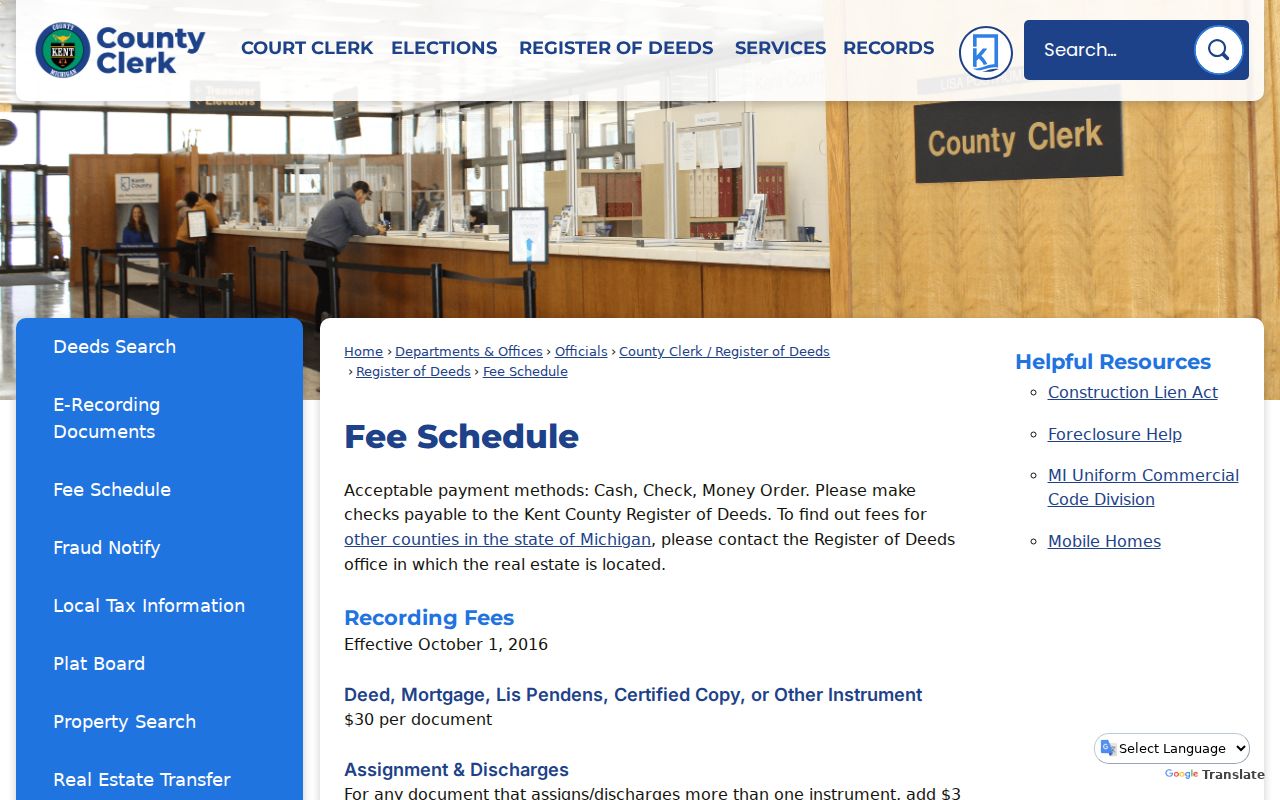
Check the live schedule because image, card, and recording charges can change after publication.
Recorded, not guaranteed. The Kent County index shows filed instruments. It is not a title opinion, and unrecorded interests or index errors may exist.
Stuck at the online search? Call or write the Kent County office with a tight, specific request. Leave legal conclusions about title to a title company or attorney. Want a fuller ownership timeline? The past property owners route traces the chain backward. It does not stop at a single copy.
A strong written request opens by stating whether you want a plain or certified copy. Then list every locator you have. Have a document number? Include it. Instrument type, grantor or grantee, approximate date, municipality, PPN, and legal description all help. For an older chain, add the last verified deed and its prior-reference citation. That gives staff a clear starting point and separates a copy order from a paid search.
File the response next to its index entry. Note the page count, certification status, order date, and receipt. A deed may cite an exhibit, prior instrument, plat, land contract, mortgage, or discharge. Pull that item whenever it touches the chain. Remember what certification means here. One certified deed proves only that copy's contents. It does not vouch for every earlier interest in the parcel.
Parties or the legal description may refuse to line up. Halt the chain and resolve the conflict first. Check spelling variants and spouse or co-owner names. Check trust and estate capacity, inactive parcels, parent PPNs, and recorded correction instruments too. A later tax-roll label or mailing address cannot cure a missing conveyance. Keep a record of the uncertainty and the searches you ran.